

What Is a U-Factor? Window Energy Ratings Explained for Architects
If you're wondering what a U-factor is in windows, here's the short answer. It's the single number that decides whether your window specification passes plan review in Philadelphia or gets kicked back.
As of July 1, 2026, Pennsylvania's adoption of the 2021 Uniform Construction Code requires fenestration to hit a whole-window U-factor of 0.30 or better. A lot of products that architects and builders have specified for years don't meet that number. Most teams don't find out until the permit reviewer tells them.
This guide covers what the U-factor measures, how the NFRC rating system works, how U-factor differs from other window energy performance ratings, and what number you should actually be writing into your Division 08 specifications.
What Is a U-Factor in Windows? (The 30-Second Answer)
A U-factor measures how much heat passes through a window assembly. The lower the number, the better the window insulates.
Technically, U-factor (sometimes called U-value) is the rate of heat transfer through a material, expressed in BTU/hr·ft²·°F in the United States. It works as the inverse of R-value. Insulation is rated by resistance to heat flow, where higher is better. Windows are rated by heat transmission, where lower is better.
For context in today's market:
U-0.30 is Pennsylvania's new code maximum for most fenestration
U-0.25 to U-0.28 is a solid high-performance window
U-0.16 is Passive House territory. Cascadia fiberglass, for example, achieves U-0.16 whole-window, which is nearly double the code requirement.
That range matters. A window at U-0.30 barely clears the bar. A window at U-0.16 gives your energy model room to breathe. More on that later.
How the NFRC Measures U-Factor and Why Whole-Window Matters
The National Fenestration Rating Council (NFRC) is the independent third-party body that certifies window energy performance in the US. When a code official asks for U-factor documentation, they want theNFRC-certified whole-window rating, not a manufacturer's marketing number.
Center-of-Glass vs. Whole-Window U-Factor
This one trips up even experienced specifiers. There are two ways a manufacturer can quote U-factor.
Center-of-glass U-factor measures only the glazing at its best-performing point. It ignores the frame, spacers, and edge-of-glass effects, so it always looks better on paper.
Whole-window U-factor measures the complete assembly: glass, frame, sash, and spacers together. This is the number the NFRC certifies and the number your code official will check.
A window with an impressive U-0.24 center-of-glass rating can easily land at U-0.32 whole-window once a poorly insulated frame gets factored in. That window fails plan review. Always specify and verify whole-window U-factor.
How to Read an NFRC Label
Every NFRC-certified window ships with a label showing four or five ratings. Here's what each one means.
U-Factor: heat transfer rate. Lower is better, and this is your code compliance number.
Solar Heat Gain Coefficient (SHGC): how much solar radiation passes through, on a 0 to 1 scale.
Visible Transmittance (VT): how much daylight passes through.
Air Leakage (AL): air infiltration through the assembly. This rating is optional.
Condensation Resistance: how well the window resists interior condensation. Also optional.
For permit submittal in Pennsylvania, the U-factor line is the one that gets scrutinized. A complete NFRC documentation package with labels, certification, and compliance confirmation is what keeps your submittal moving.
U-Factor vs. R-Value, SHGC, and Other Energy Performance Ratings
Architects and GCs often ask how U-factor relates to the other numbers floating around a window schedule. Here's the quick comparison:
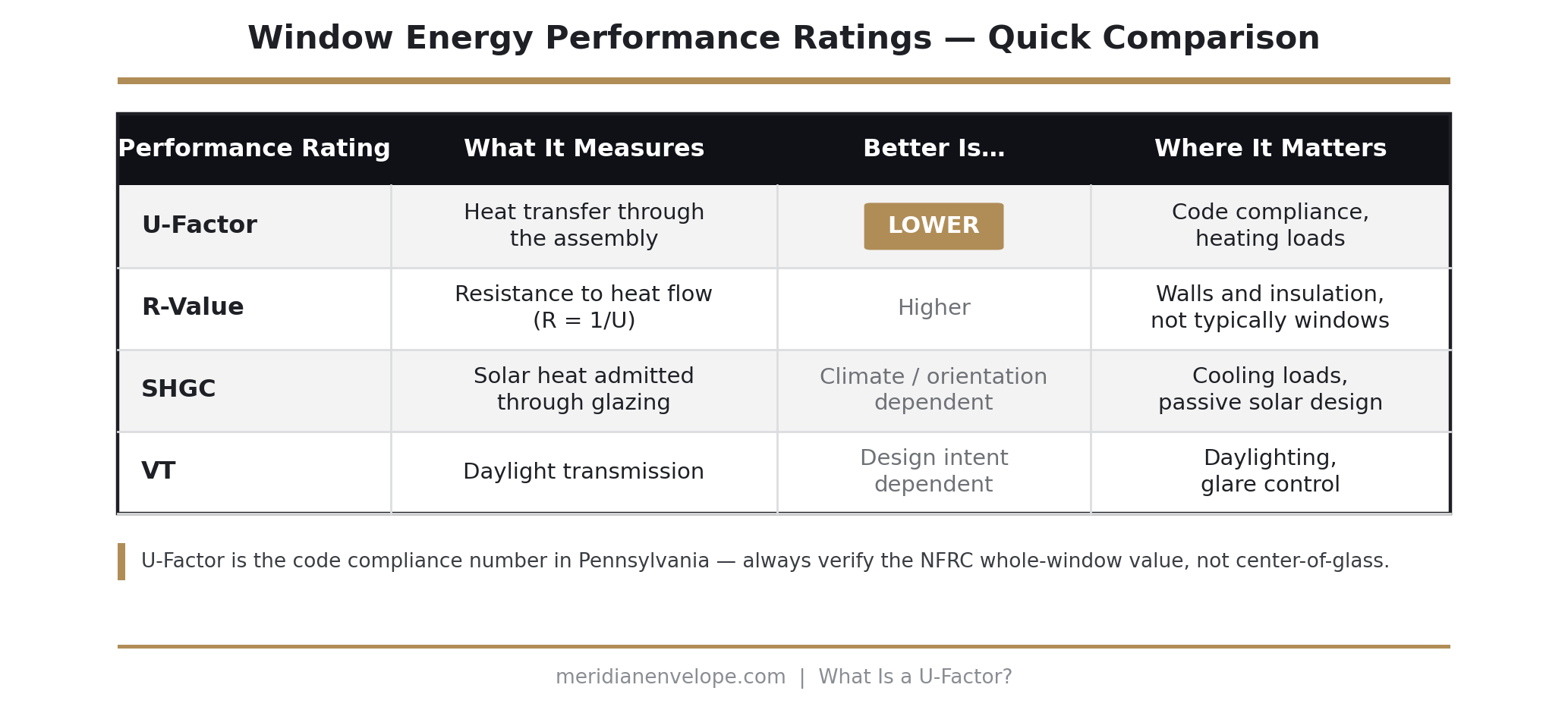
Comparison table of window energy performance ratings showing U-factor, R-value, SHGC, and visible transmittance — U-factor is the code compliance metric for Pennsylvania window
Two practical notes for the Philadelphia climate zone.
U-factor drives heating-season performance, which dominates energy use in our region. It's the number with regulatory teeth.
SHGC is a design decision as much as a compliance one. South-facing glazing in a rowhouse renovation may benefit from moderate solar gain. A west-facing glass wall probably won't.
If you only track one number for code purposes in Pennsylvania, make it U-factor.
Why U-Factor Now Decides Permits in Philadelphia
Pennsylvania's U-0.30 Requirement Under the 2021 UCC
Pennsylvania adopted the 2021 Uniform Construction Code with a fenestration performance standard of U-0.30 maximum, effective July 1, 2026. That's a meaningful tightening from the previous standard, and it isn't a suggestion. Every permitted project with new or replacement fenestration must document compliance.
Here's the problem. A large share of the window products historically specified in the Philadelphia market, including familiar national brands, do not meet U-0.30 whole-window. Specs that sailed through plan review in 2024 can now come back with rejection letters.
https://www.meridianenvelope.com/blog/philadelphia-energy-code-2026-window-requirements
What Happens When a Spec Fails Plan Review
When a plan reviewer flags non-compliant fenestration, the downstream costs stack up fast.
Resubmittal delays. Weeks get added to the permit timeline while the window schedule is revised.
Redesign costs. Substituting a different product line can change rough openings, sightlines, and elevations.
Buyout disruption. GCs holding pricing on a non-compliant product have to re-quote mid-project.
Schedule compression. Lead times on the replacement product start from zero.
The fix is simple, but it has to happen early. Verify the NFRC whole-window U-factor of every product in your window schedule before permit submittal. A fenestration compliance review at design development costs nothing compared to a rejection at plan review.
What U-Factor Should You Specify?
Code Minimum vs. High-Performance vs. Passive House
There are three tiers to think about when writing a U-factor into your window specification.
Code minimum (U-0.30). Compliant, but with zero margin. If field measurements, product substitutions, or configuration changes push the number up even slightly, you're non-compliant. Larger units and certain operating styles often rate worse than the tested baseline size.
High-performance (U-0.20 to U-0.27). This tier gives you a comfortable compliance buffer, better occupant comfort near glazing, and a real reduction in heating loads. Thermally broken aluminum systems like Reynaers achieve U-0.23, which combines slim European sightlines with performance well beyond code.
Passive House certified (U-0.16 or better). Products like PHIUS-certified Cascadia fiberglass at U-0.16 nearly double the code requirement. Beyond compliance, this tier gives the energy modeler thermal flexibility. A window that outperforms code can offset a tradeoff somewhere else in the envelope.
For most premium residential and boutique multifamily work in Philadelphia, specifying below U-0.25 is the pragmatic sweet spot. You get durable compliance, better comfort, and no redesign risk.
How Frame Material Affects U-Factor (Aluminum vs. Fiberglass vs. Vinyl)
Frame material is one of the biggest levers on whole-window U-factor, because the frame is usually the weakest thermal link in the assembly.
Fiberglass has inherently low conductivity, stays dimensionally stable, and can reach Passive House-level performance. It's the strongest all-around performer for U-factor-driven specs.
Thermally broken aluminum solves aluminum's biggest weakness. Standard aluminum conducts heat readily, but modern European systems insert insulating thermal breaks in the frame and reach U-factors in the low 0.20s while keeping the slim profiles architects want.
Vinyl offers decent thermal performance at a low cost, but it's limited in large-format sizes, dark colors, and the structural spans common in contemporary design.
Wood is a good insulator with a traditional aesthetic, but it's maintenance-intensive and often harder to certify at aggressive U-factors in large units.
The takeaway here is that material choice isn't just aesthetic. If your design calls for large-format glazing or slim sightlines, plan for a frame system engineered to hit your U-factor target at those sizes, not just at the NFRC test size.
A U-Factor Checklist for Your Next Window Specification
Before your next permit submittal, run every product in the window schedule through this list.
Confirm the whole-window U-factor, not center-of-glass, for every unit type and operating style.
Verify NFRC certification. Request the certified performance data, not a brochure number.
Check large and non-standard sizes separately. U-factor can degrade on oversized units.
Match the spec to the energy code path, whether that's prescriptive U-0.30 compliance or performance-based modeling.
Collect the documentation package: NFRC labels, U-factor certification, and code compliance confirmation, ready for the plan reviewer.
Build in margin. Specifying at or below U-0.25 protects the project against substitutions and configuration changes.
If any product in your schedule can't clear these six checks, resolve it in design development, not at plan review.
The Bottom Line
U-factor is no longer a background technical detail. In Philadelphia, it's the number that decides whether your fenestration spec passes permit, how your building performs, and how comfortable it is to occupy. Specify whole-window NFRC-certified ratings, build in margin below the U-0.30 code line, and get your compliance documentation in order before submittal.
Not sure whether the products in your current window schedule meet Pennsylvania's U-0.30 requirement? Meridian Envelope Solutions offers a complimentary 20-minute fenestration compliance review for architects, builders, and developers in the Philadelphia area, with certified documentation for every product we supply.
Let’s Work Together
Questions about your glazing specifications or upcoming project? Meridian Envelope Solutions supplies NFRC and AAMA certified window, door, and glazing systems to builders, developers, and architects across Philadelphia and the Northeast. We are happy to help.